
Basics of Heat Transfer in FRP Cooling Towers
Key parameters for heat transfer in FRP cooling towers: range/approach, airflow, fill efficiency, and quick troubleshooting.
Basics of Heat Transfer in FRP Cooling Towers
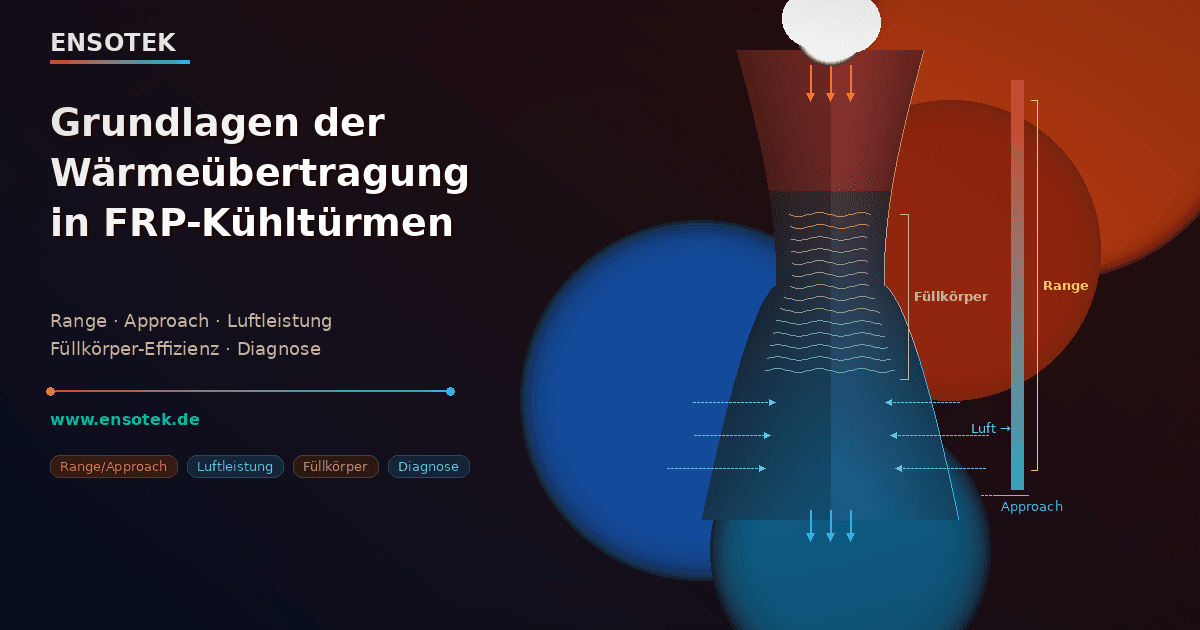
Heat transfer performance depends on airflow, fill efficiency, and stable water distribution. This article summarizes key metrics (range/approach), common site issues, and quick troubleshooting tips.
Core Metrics
Range
Difference between inlet and outlet water temperature. Indicates load and capacity utilization.
Approach
Difference between outlet water temperature and wet-bulb. Lower approach typically means better performance.
1) Airflow
- Fan speed (VFD), blade angle and surface condition
- Blockage at air inlets and louver condition
- Recirculation and short-circuit airflow
2) Fill Efficiency
- Surface area and contact time
- Scaling and biofouling
- Fouling due to inconsistent water treatment
Quick Troubleshooting
| Symptom | Likely cause | Check |
|---|---|---|
| Approach increases | Fouled fill / low airflow | Fill/nozzles + fan current |
| Range decreases | Load/flow change | Flow measurement + process |
| More droplet carryover | Damaged drift eliminator | Eliminator inspection |
Practical Tip
Track trends: at similar wet-bulb conditions, record approach/range and fan energy. Deviations are early-warning signals.
Contact
Call us
+90 212 613 33 01
Email us
ensotek@ensotek.com.tr
Address
Oruçreis Mah. Tekstilkent Sit. A17 Blok No:41 34235 Esenler / İstanbul, Türkiye, Istanbul, Türkiye

Reviews
No reviews yet.
Write the first review!